Why Landlords Love Pets But Do Not Love ESA

Walk into almost any professionally managed apartment community today and you'll notice the trend: dog parks, pet-wash stations, "bark parks," and Instagram walls featuring residents' furry companions. Leasing agents often gush about how "pet friendly" the property is, and developers build entire amenity packages around catering to renters with pets.
The Hidden Economics Behind Pet Policies
On the surface, it looks like a golden age for renters with pets. Yet dig deeper, and you'll find an uncomfortable tension: many of these same management companies take a hard stance against emotional support animals (ESAs). They may not be able to refuse them—federal fair housing law protects tenants with ESAs—but they often resent the requests, scrutinize the paperwork, and frame ESA accommodations as an inconvenience.
So why do professionally managed multifamily properties "love" pets but "hate" ESAs? The answer comes down to economics, control, and compliance.
Pets Are a Profit Center
First, let's look at the scale. Roughly 65 to 70 percent of apartment units are home to at least one pet. Among those households, about 30 percent have two pets. That means pets aren't just common—they are the norm in multifamily living.
Property managers and asset owners have turned that prevalence into a reliable ancillary income stream. The typical revenue model for pets looks like this:
- One-time, non-refundable fees: $300 to $500 per pet at move-in
- Monthly pet rent: $25 to $45 per pet, billed alongside standard rent
Run the numbers and it's easy to see why pets are loved by management. For a single pet, an operator can expect $600 to $1,000+ in revenue each year when combining the upfront fee and ongoing pet rent. For two-pet households, the totals double.
The Scale of Pet Revenue
Scale that across a professionally managed community of 1,000 units:
- 700 households with pets (70 percent penetration)
- Factoring in multi-pet households, that's roughly 910 pets
- At $600 to $1,000+ per pet, the property is collecting $600,000 to $900,000 in annual recurring revenue
- Plus another $300,000 to $450,000 in one-time fees
That's why you see so much enthusiasm for "pet friendly" marketing. Pets equal profit.
ESAs Break the Model
Now let's bring ESAs into the equation. Under the Fair Housing Act (FHA), landlords cannot charge pet fees, deposits, or monthly rent for a legitimate emotional support animal. They also cannot enforce breed, weight, or size restrictions if a resident presents proper ESA documentation.
In practice, that means every ESA effectively erases the revenue stream management has come to depend on.
Industry estimates show about 15 percent of renters with pets claim an ESA. Using the 1,000-unit community example above:
- 700 pet households × 15 percent = 105 ESA households
- With an average of 1.3 pets per ESA household, that's ~135 pets
- Every one of those pets wipes out $300 to $500 in one-time fees and $300 to $540 in annual rent
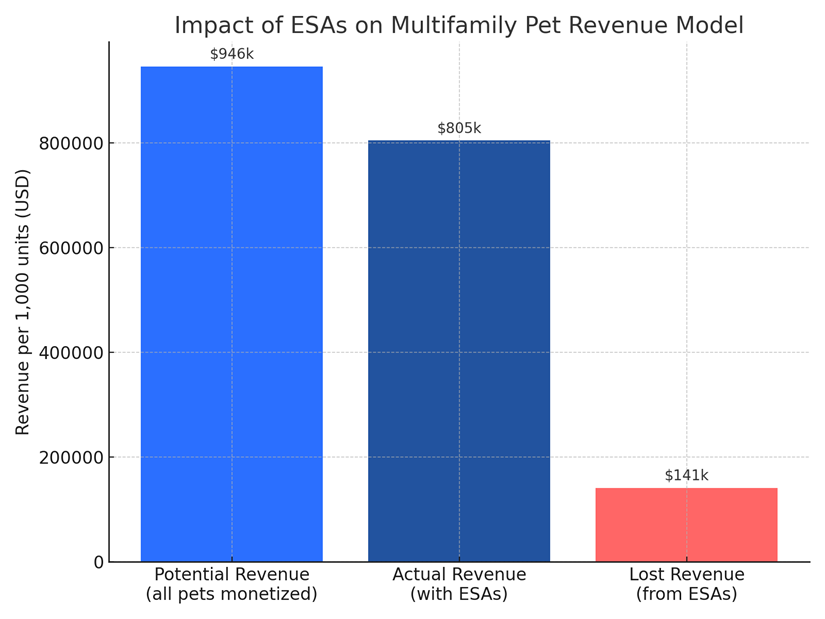
Total annualized revenue lost: $80,000 to $135,000 per 1,000 units
This represents the equivalent of losing multiple leased units of income every year.
Loss of Control
It's not only the money. Management also loses a sense of control when ESAs enter the picture.
With regular pets, operators set the rules: weight limits, breed restrictions, caps on number of animals, even which floors or buildings allow pets. These controls are framed as risk management but also serve to make pets more predictable as a revenue stream.
With ESAs, many of those levers disappear. A valid ESA letter can override breed bans, weight caps, and pet limits. Leasing staff no longer gets to say "no large dogs" or "no more than one pet." The law requires flexibility. For property managers, this feels like an erosion of authority over their community standards.
Compliance and Legal Risk
Another reason multifamily dislikes ESAs is the compliance burden. Staff must be trained to recognize what documentation is acceptable, what questions they are legally allowed to ask, and how to process accommodation requests.
Get it wrong one way, and they risk allowing fraudulent documentation. Get it wrong the other way, and they risk a HUD investigation or a costly fair housing complaint.
From the perspective of a management company, it can feel like being stuck between a rock and a hard place: lose revenue if you accept ESAs, or face legal liability if you don't.
The Bigger Picture
From the renter's side, this dynamic often feels unfair. Why should a tenant with a legitimate disability and a prescribed ESA be treated with suspicion? Why should property managers care more about protecting revenue than supporting residents' well-being?
The reality is that both perspectives are valid. Renters need their ESA accommodations to live comfortably and legally. Property managers are tasked with protecting income streams and ensuring compliance across large portfolios.
Some forward-looking operators are reframing ESA verification not as a revenue loss, but as a service opportunity. By partnering with trusted platforms to verify documentation, they reduce legal risk, streamline operations, and maintain positive relationships with residents. Rather than treating ESAs as the enemy of revenue, they view proper verification as a way to build trust and differentiate themselves in a competitive rental market.
Conclusion
Professionally managed multifamily operators love pets because pets are predictable, profitable, and controllable. They dislike ESAs because ESAs disrupt the revenue model, reduce management control, and add compliance risk. With 15 percent of pet households claiming ESA status, the financial stakes are significant, often $80,000 to $135,000 in lost income per 1,000 units.
But resistance isn't a viable business strategy. Operators who find ways to accommodate ESAs while protecting their operations will be best positioned to thrive in a market where both pets and emotional support animals are here to stay.